Making Our Way Down From Everest Base Camp

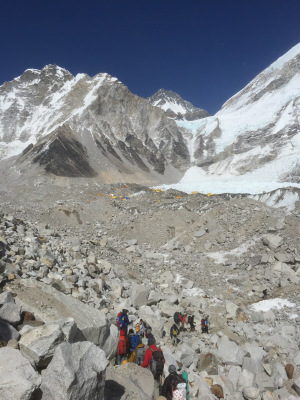
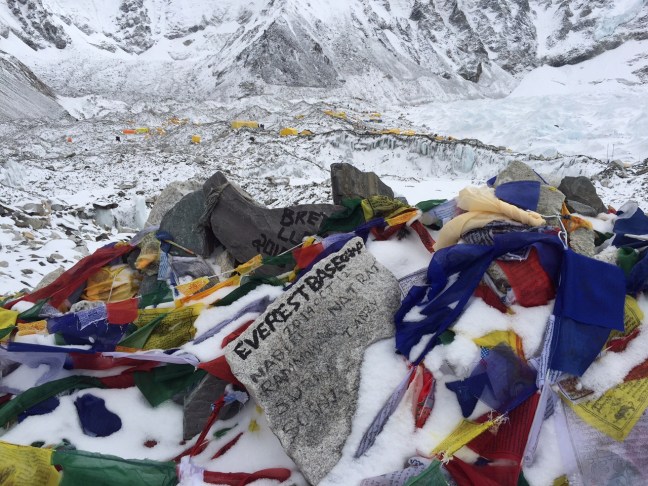
I wasn’t prepared for what happened to me emotionally as I left Everest Base Camp.  Greg had outlined the plan to us the night before, and I knew I was headed to Pheriche for our first overnight on the way out. Five minutes out of EBC I came to the Base Camp Rock.  Most climbers and trekkers take a picture here as they first arrive.  There have even been marriages performed in front of this rock overlooking the vast camp. As I stood there to take a picture, the weight of the entire experience finally hit me.  A real tragedy had just taken place.  People had lost their lives here just hours earlier.  And, personally, this was likely the last time I’d be here, and, likely, the end of my dream.

I cried for a while before I finally left.  Some of my fellow team members stopped as well with the same reaction.  I stopped several times over the course of the next half hour or so to look back and catch some final glimpses of camp.  I chose to walk alone for most of the five-hour trek down to Pheriche.  The heaviness in my heart gradually lifted, and I was feeling much better by the time I arrived.

Pheriche, like Lobuche, had a few buildings that had considerable damage from the earthquake.  The tea house we stayed at on the way up was one of those.  It had sustained enough damage to be completely closed.  We were forced to camp in a yak field behind it next to a tea house called the White Yak.  We had dinner at an adjacent tea house and relaxed afterwards as a group by playing Name That Tune.  It was good for all of us, as we found a healthy way to release all the built-up anxiety from our intense experience.

After a decent tent slumber we had breakfast and began our journey to Phortse.  Phortse is not on the regular trek out, but given the situation at Lukla – with a bottleneck there, causing some 1500 trekkers and climbers to wait in queue – Greg decided we would be better off, in effect, stalling on the way down to allow it to clear out a bit.  Kathmandu also had many problems we thought may get a little better if we delayed our arrival.  Since many of IMG’s Sherpa have come from Phortse over the years and some of their homes were damaged in the earthquake, we decided to go out of our way and spend several days there helping.

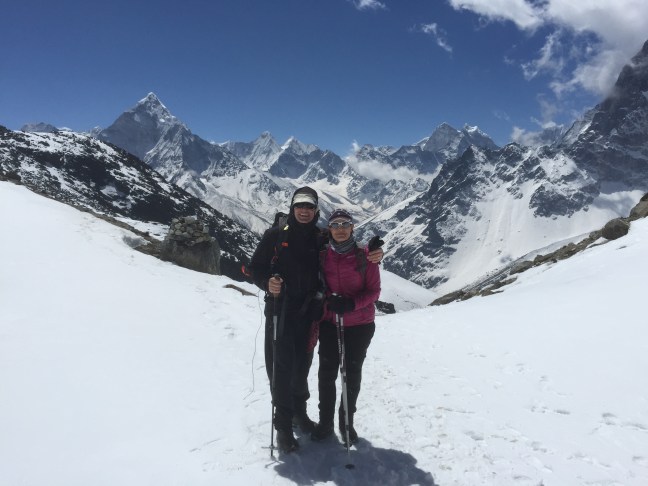
The view from the other side of the canyon, overlooking such places as Tengboche, was fun and interesting, and steep!  The trail is not for the faint of heart!  It took half the day to finally arrive at Phortse, but was well worth it.  It’s such a cute little village!  It sits on the side of the mountain on what looks like a tabletop or shelf.  It’s untouched by tourism and has amazing views!  None of us minded spending the next two and a half days killing time and helping with some of the damaged buildings, including a young family’s home and a monastery.  In fact, I kinda fell in love with cute little Phortse!  I loved walking the narrow dirt walkways that linked all the homes and tea houses together.  I imagined being a young boy playing hide-and-seek with friends and having the time of a boy’s life!  I also enjoyed the 20-minute walk around the mountain to a point where I could not only get better reception to call Judy twice a day to check in, but could overlook Tengboche.  From there I also had a view of Ama Dablam, as well as the spectacular Kantega and Thamserku!  We had hoped to help with the damaged school and medical clinic, but they required some extensive evaluation before work started and that didn’t happen before we had to leave.  As it was, we stayed three nights then made our way to Namche Bazaar.

The hike started with a steep drop to the river off the tabletop that is Phortse.  It took about 20 minutes to reach the river before a very steep 1000-foot climb to the high point of the day’s walk.  It was a very pleasant day with beautiful views of the mountains, especially with all the Rhododendrons in bloom.  We arrived at Namche by about noon and had our sack lunch at the grassy area near the top that would become our tent site.  After lunch we shopped and had some more to eat and drink at one of my favorite bakeries.  I noticed enough damage on some of the buildings to be concerned, but not as much as I expected to see.  We were advised, however, to stay out of the buildings just in case, as aftershocks were still expected.  Tonight would be the last tenting night and the tenth with Jim Davidson.  I appreciated that it was on relatively flat ground as opposed to the 10-15% incline at Phortse, which kept me at the bottom of the tent all night.

The next morning dawned clear and beautiful, and we all started our last day of hiking, going down through Namche and losing altitude quickly through the steep village.  One home near the bottom had been completely destroyed by the earthquake after it caught fire.  It was the worst I’d seen so far.  I enjoyed hiking the steep trail through the forest and down to the river, especially trying to keep up with three happy teenage Sherpa girls.  I wondered why they might  be in such a hurry, but concluded it was probably their normal pace.  From the high bridge over the river at the bottom to Lukla, it was green and beautiful.  The last two hours from Phakding to Lukla were uphill and it seemed to take forever.  After another five to six hours of hiking, I was really ready to be done.  For the third time during the trip, I was the first to arrive – first, the peak of Lobuche. second, Camp 1, and now, finally, Lukla.  It felt good!  I was satisfied with my training, especially being one of the oldest.  Don Harbart had actually just turned 61, so he is about nine months older.  If I had to do it over, I would slow down and eat and hydrate more, especially to Camp 1.  I would do that because I think I’d recover quicker.  Anyway, it was good to be back in Lukla, and we all celebrated.

The weather forecast for the next morning was good, and I was especially excited to take off in a fixed-wing aircraft.  Three years ago we were forced to pay extra to take a helicopter down to Kathmandu because of the weather.  Even though I had the front seat then and could see a lot more, a helicopter is slower and less exciting on the takeoff.  Flying down the runway in a fixed-wing and sailing off the steep drop off at the end is my idea of a good time!  We passed over many villages on the way down to Kathmandu and I looked carefully for more earthquake damage.  We were too far away to really see details of the homes and tea houses, but I saw plenty of orange tarps indicating make-shift tents.  I assumed that meant there had been plenty of damage to homes.

After about 45 minutes we made the approach to the runway, passing over parts of Kathmandu.  Again, it was impossible to see the damage to homes and buildings.  I didn’t see any totally collapsed buildings, but I did see military aircraft from several countries on the side of the runway as we landed.  We had been told that supplies from all over the world had already arrived, and I could see evidence of such as we taxied. We bussed 15 minutes to Hotel Tibet, and, again, I didn’t see much evidence of an earthquake. It hadn’t affected this area very much.

We checked into the hotel about 9:00am and learned our rooms wouldn’t be ready for several hours. Jason and Caroline Ahlan found a spa nearby where we could get a massage, manicure, pedicure, and scrub for a ridiculously low price.  So, that’s where I spent the next few hours waiting for a room.  It was wonderful!  It felt good to be squeaky clean again!  We had a nice dinner at the hotel. I roomed that night with Andy Land, a very pleasant hospice nurse from Wisconsin, whom Judy and I had come to like quite well.  We had fun and joked as we tried to stuff one duffel instead of two (our climbing duffel is still on the mountain somewhere between EBC and Lukla on a yak) with all of our stuff, which now included some extra gifts for friends and loved ones at home.  

We had a decent night’s sleep, took another shower in the morning, had breakfast, and were again bussed back to the airport.  We picked up some of the team on the way, who were forced to stay at the Yak and Yeti as Hotel Tibet was short on rooms.  The Yak and Yeti is much nicer, but it cost them three times as much money.  We were all aware from the beginning that we would be paying for our own room in Kathmandu on the way home.  So at this point it was just kind of luck of the draw when some of us ended up at one place and some another.  Our departure was uneventful, and before I knew it we were in the air and finally on our way home.
Icefall, Camp 1, and Earthquake

“Bart felt the earthquake at Camp 1.  He called Judy to let her know he was ok.  The climbers were flown by helicopter back to Everest Base Camp, where Bart is now.  Their plan is to pack up EBC and leave the day after tomorrow and slowly make their way down to Kathmandu.  He is in good spirits and good health.”

The message above was the best and quickest way I knew of to get the message out that I was okay at Camp 1.  I had Judy call my business partners, John and Margaret Hallgren, who were updating my blog when I could not, to quickly post it. I will now recount below how the day played out:

I reached Camp 1 at 8:00am and immediately called Judy on the satellite phone.  She was relieved to learn I was there safe and sound, given the risk of the Icefall.  It had taken me five hours and I was exhausted. The rest of the team trickled in over the course of the next hour, and I took pains to hydrate, medicate, and eat to mitigate the effects of altitude and dehydration.

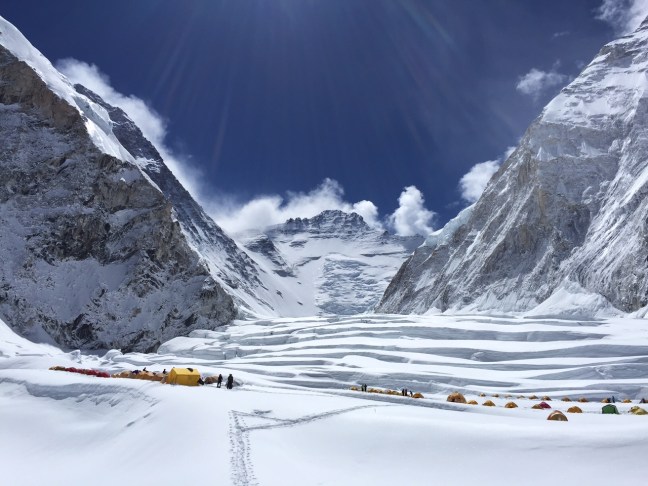
The Icefall was all I expected and more!  It was just as difficult as I’d been told and every bit as spectacular as I expected.  It was like exploring canyons in my youth at Lake Powell, in that something interesting and exciting lurked around every corner!  I didn’t think once about the danger as I crossed crevasse ladders and underneath leaning seracs!  Climbing vertically up the five stories of ladders to the Western Cwm towards the end was the hardest part!  Jim Davidson, my tent mate, had been leading the way until I finally passed him as he stopped to add some sun screen. He admonished me to stay clipped to the fixed line all the way into Camp 1 even though Bhote, my Sherpa, was not.  I’m sure he was drawing from his tragic experience on Ranier many years earlier. Eventually camp filled up with the remainder of the team, and we had all retired to our tents to rest.

Suddenly, at 11:56am, we heard avalanches coming down from both Everest and Nuptse at the same time! The glacier underneath us bucked and heaved as they pounded the Western Cwm.  Jim and I were both familiar with times in the past when they had buried tents at Camp 1 and knew we were somewhat vulnerable there!  Jim yelled, “Grab your avalanche beacon, your helmet, and your down coat, and let’s get out of here!”  Fortunately, I already had my down booties on, so I was able to quickly jump out of the tent to see if the avalanches were headed our way.  Unfortunately, visibility was very low and we couldn’t be certain. We could only hear them and they all seemed to be coming in our direction. Just then a strong and sustained wind hit us and it seemed inevitable that we were about to be covered. We were terrified!  I was dressed in down from head to toe, but saw others like Jason Ahlan running in long underwear with bare feet!  We really had nowhere to escape.  It seemed avalanches were coming at us from all sides! Running would hardly have been an option anyway.  We had next to no visibility, and Camp 1 is surrounded by both seen and unseen crevasses!

I saw some of the team crowding into one of the larger-domed Sherpa tents and I did so as well.  Several Sherpa were nervously chanting Buddhist prayers with fervor and I wondered what they were thinking, although it was fairly obvious.  The wind which precedes an avalanche continued. I thought maybe all the bodies in the tent might create some air pockets when we were covered, but remember thinking this is the one way I don’t want to die.  I’m so claustrophobic and I have always feared suffocating to death.  But gradually the wind began to die down.  I felt a sense of relief and backed out of the tent to find a couple of teammates standing there stunned.  One was Nic Dumesnil, a 30-year-old Canadian, who had been impressing me the whole trip with his unusual intelligence.  We immediately gave each other a giant hug and looked at each other with great relief in our eyes.  Gigi, a cute young Moroccan, was also standing there, and I put my arm around her to comfort her.  She turned and hugged me so hard it hurt!  She wouldn’t let go!  Finally, she did and again we looked at each other with great relief!  Everybody began appearing from their hiding places, with the same look of relief.

We started hearing radio chatter from Everest Base Camp about an earthquake that had just wiped out the whole middle section of the mile-plus-long EBC below.  It was the first time I began to rethink what had just happened.  Instead of the avalanches causing the ground to rumble and buck, it was an earthquake that had caused the avalanches.  It made sense!  Jim Davidson, a geologist, tried to piece together what he thought may have happened at Base Camp.  Since we still had few details, he surmised that the earthquake had caused half of the camp to collapse into an air pocket under the glacier the camp sits on. It sounded feasible to me, until we heard what had actually happened a few hours later.

A giant hanging glacier between Pumori and Lintgren, directly above and to the west of camp, released due to the earthquake and made its way down into a gully before gaining tremendous momentum on a cushion of air, spraying rocks and ice as it came up and over Base Camp.  It tore many tents to shreds and scattered debris for hundreds of yards.  We heard preliminary reports that some people had even been killed.  We hadn’t yet heard how wide-spread the earthquake was across Nepal, but it immediately dawned on me I needed to let Judy know ASAP.  I called her again, this time at about 1:30 in the morning, her time in Utah.  I gave her a chance to sit up and get the deep-sleep cobwebs out enough to understand what I would tell her.  I said I’d just experienced an earthquake and avalanche dusting, but was unharmed and okay.  I told her to be prepared for news and phone calls when she awoke in the morning.  I had the only sat phone, so most of the other climbers asked to use it to call their loved ones, as well. The Sherpa also asked and I had to decline because I thought my sat phone battery was low.

Meanwhile, Camp 1 was all a buzz about what might happen next.  It wasn’t long before the first of a couple of big aftershocks occurred.  The first one hit about 3:00pm.  The glacier bucked again like the first time but I don’t remember any more avalanches.  Soon evening arrived and I wondered what might happen that night.  Fortunately, nothing did but none of us slept well.  The next morning we were all still asking lots of questions and wondering, selfishly, if our climb might be over.  Just as I was finishing lunch an aftershock of 6.7 hit and it felt almost identical to the first one.  This time I stayed in my tent and waited. A similar wind came through camp again, but this time it died down more quickly, giving me relief.

The difference after this aftershock was the Sherpa.  They had been nervous like the rest of us, but after this one they became more and more agitated.  They began complaining that they were not being kept in the loop. They had very little knowledge of the condition of their own families and homes.  They had witnessed the climbers call home on my satellite phone to communicate with their loved ones, but they had not had the same opportunity.  One had tried using my phone but had no success getting through.  I felt bad I had denied use to the others, but I was worried I’d run out of battery and not be able to contact Judy if we were stranded for an extended length of time.

An argument ensued between the Sherpa and an IMG guide, Emily, and she eventually radioed EBC to solicit the help of head Sherpa, Jangbu, to calm the situation.  One of the main concerns was the belief that another aftershock would open a crevasse through the middle of camp, swallowing us all. When attempts to dissuade them of that belief failed they insisted on leaving immediately by way of the Icefall. Though the Icefall ladders had all been destroyed and many of the seracs had tumbled making it extremely dangerous, they were ready to give it a try.  Jangbu was once again able to dissuade them of this misguided notion.  Realizing they would be forced to spend another night, they anchored a climbing rope at various places through the middle of Camp 1 and clipped into it for the duration, believing that would stop a fall into the depths should a crevasse open up.

I actually slept better the second night.  I hadn’t slept more than an hour for the past three nights combined, so my body was so fatigued I slept better even though my tent mate,  Jim Davidson, was being interviewed on and off through the night by CNN on my sat phone.  I had been wrong about the battery on my phone.  I was actually running out of usage minutes, not battery.  A call to my provider restored another unit, about three hours, and Jim urged me to let him use it for the interview with a promise to repay me.  The sat phone seemed to work a little better outside the tent, so he was in and out several times during the night.  I learned later my son, Don, heard the interview at home.  Little did he know where and how it had taken place.

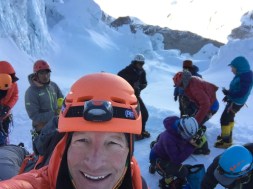
Our third day was clear enough to start our evacuation, and since none of us had been swallowed by a crevasse overnight, we all packed and lined up about 200 yards away and waited for our rescue helicopter to appear.  I have to admit I was somewhat reluctant to leave.  I kept wishing we could make the relatively easy hike to Camp 2 to continue our rotation.  I was in a bit of denial that my dream of climbing Everest was almost certainly over.  But soon two helicopters appeared from the direction of the Icefall and began ferrying us two by two back to EBC.  My toes were cold as I stood in line waiting my turn despite wearing my expensive 8000-meter boots.  I kicked the snow and wiggled them to avoid frostbite in the sub-zero temps.  The rest of me was warm, as I had been wearing my summit suit since arriving, even to sleep in. It was finally my turn after about an hour and I boarded the seatless helicopter with a light pack and one other Sherpa.  We left our climbing gear behind for weight purposes, and I worried whether I’d ever see it again.

The ride down to Everest Base Camp was thrilling!  After a slow lift off and flying over the last half mile of the Western Cwm, we literally plummeted down the Icefall.  My heart came up into my throat as I realized there was absolutely nothing to hold on to.  Sitting Indian style I held my balance the best I could, and within several minutes we landed at IMG’s EBC site!  The Icefall had been destroyed by the earthquake, but we passed by it so fast I couldn’t tell.  I didn’t see any of the 50 or so ladders I had crossed coming up. Greg Vernovage, the expedition leader, and the rest of the staff were there with a hearty greeting when we landed.  Mike Hamill, one of our favorite guides, quickly poured just two and a half gallons of fuel into the helicopter, and sent it back up to retrieve the next in line.  It was probably about 8:00 or 9:00am by then, and I watched on and off till about 4:00pm for the last of about 160 climbers to be rescued.

During the day I learned of the heroic effort by so many that had occurred over the past couple of days right in our IMG camp.  Due to its size and location (untouched by the avalanche) Greg had volunteered its use as a triage center, converting our dining and communications tents to trauma centers.  By the time I arrived, it had been restored to its prior state. It was hard to believe as I heard story after story about success and failures in keeping people alive.  One person had died twice right where I was sitting only to be revived and flown to a hospital down valley.  Another, unfortunately, wasn’t as lucky and had died during the first night, despite efforts by a cardiologist acquaintance of mine, Ellen Gallant, to save the 25-year-old Sherpa who died of head trauma.  Four bodies in their sleeping bags (used as body bags) covered by a blue tarp lay not far from my tent, reminding me of what must have been a horrific 23 hours, which was the amount of time it took from when the avalanche first hit to the time the last survivor was flown out – 23 hours of hell I had thankfully missed.  However, my friend, Fraser, from Australia said as hard as it was it had its rewards, as I’m sure it did by the stories I heard.

That night as we sat at dinner, Greg recounted all that had happened.  He was proud of everyone!  And we were all so proud of him. Among other things he’s a former Olympic coach to the Women’s Volleyball Team and had impressed me throughout the expedition in many ways.  I was particularly impressed when he confessed about a difficult decision he had made during the crisis.  When HRA (Himalayan Rescue Association) ran out of oxygen, and more was needed to keep people alive, he volunteered the climbers’ Os, doing so even at the urging not to by our head Sherpa, Jangbu.  He argued to bring it down from camps that had already been destroyed and whose climbers were either dead or injured and unable to continue anyway.  It was a good point because our expedition hadn’t officially ended yet, though the writing was inevitably on the wall, but Jangbu could see the potential to keep it possible.  Greg insisted there were those whose health may be compromised and he would use the climbers’ oxygen immediately for them.  In my eyes, Greg became a true leader at that moment, even though I knew it meant I’d hear what I would dread hearing – our expedition was over.  Indeed, the announcement to end it came in his next breath.

The expedition was officially ended.  It really came as no surprise, but wouldn’t hit me emotionally till a couple of days later as I departed EBC.  That’s when I came to the realization that my life-long dream of climbing Everest was most likely over.

Leaving for Camp 1 and 2

Icefall Leaving for Camp 1 and 2

I’ll be leaving in a little more than 12 hours on the first rotation to camps 1 and 2. I’ll be spending two nights at each, then returning to EBC to rest. I’m not sure if I’ll be able to communicate from there, but if so, I’ll call with a saAt the Football Fieldtellite phone update.

Both camps are surrounded by the huge walls of Nuptse, Lhotse, and Everest. The Icefall is in the best, quickest, and safest shape since 1979!  Just getting to the “Football Field” (about halfway) was quite possibly the most fun climb I’ve ever done, with the exception of the Matterhorn and Eiger. Well anyway, it ranks right up there!  I’m excited to experience the rest!  Will keep you posted.

PS:  I miss all of you – family, friends, clients, and colleagues.  I sincerely appreciate your interest!

Lakpa Bhote

PSS:  My Sherpa, Lakpa Bhote, who likes to be called Bhote (pronounced boatea) because it stands for the Himalaya, just now dropped by my tent to hammer out plans for tomorrow’s 3:00am departure. He happened to mention that he and a few other Sherpa had already carried loads this morning to Camp 1. They left at 4:00am and we’re back by 7:00am.  A couple of days ago it took me over two hours just to get half way to Camp 1, with a light load.  Bhote is all of 5′ 4″ and slightly built.  He’s 38, just older than my son, Don, and has three children aged one, nine, and 14. He’ll be helping me in many ways, especially to get me up and down safely.  I plan to tip him generously no matter how high I climb, as you might imagine.

The Icefall

The Icefall. Finally! I got to do what I’m here to do! Climb Mt. Everest! Climbing up through the Icefall today finally made it real.

IMG’s program is to get us comfortable with our gear, so the first time we only go up to the so-called football field, a small level place, to take a break.  We were all so excited we hiked from our camp to Crampon Point in 15 minutes. It usually takes twice that long!  I hurried to get my crampons on, but Bhote took his time.  By the time he was finally ready we were one of the last to leave.  It turned out interesting to be able to see the headlamps of most of my group up ahead winding through the maze of ice and snow towers like a snake.  I was mesmerized the entire way, wondering what curious ice shape would be lurking around the next corner!

Two hours later most of us were hydrating and eating snacks at the football field.  This tiny area, nowhere near the size of a real football field, is about halfway in terms of time to Camp 2, but more than half by distance. I’m told the second half is much steeper, with many more ladders to cross, and ends with a six-story cliff. Six ladders are stacked vertically, end to end, to allow us to get up and on to the Western Cwm.  I felt comfortable crossing about five ladders today,  but I may feel different next time as there will be about 45 more.  Every member of my group agrees the ladders are a fun and exciting part of the adventure. I guess we’re all a little sick in the head, eh?  After about a 20-minute rest, we headed down.  I think Bhote was late for an appointment, because he literally flew down in about an hour.  At times I had to run to keep up! I was exhausted!  We were down by 8:00am, and in time for a second breakfast. The first one was at 4:30 in the morning.  After some food, rehydration, and rest, I felt much better. We’ll rest now for a few days and start our first official rotation to Camps 1 and 2 this weekend.

PS:  Thanks for all the responses to this blog and to Instagram.  By the way, check out the pictures on Instagram that correspond to this blog, because it’s sometimes impossible to upload a picture to the blog. On the other hand, Instagram is fast and easy.  Try downloading the App – it’s free!  You’ll find my pictures by entering bartw55 in the search box.  I try to respond to your comments, but oftentimes the Internet is unresponsive.  When it works, I try to quickly Instagram some pictures, along with comments.  If I’m really lucky I can then get on my blog to update further.

Puja Ceremony

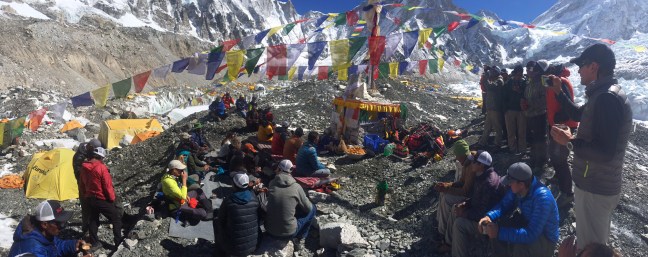
Today, I received yet another blessing for safety at the Puja Ceremony.  The Sherpa refuse to go any higher on the mountain until this is completed.  They asked us to also bring anything else we wanted to have blessed.  I noticed others bringing some of their climbing gear, so I grabbed my crampons and ice axe and placePuja Stringd them against the altar.  I noticed some of the Sherpa placing such things as Coca-Cola, beer, and other food items on the altar, as well, so I surmised anything goes!
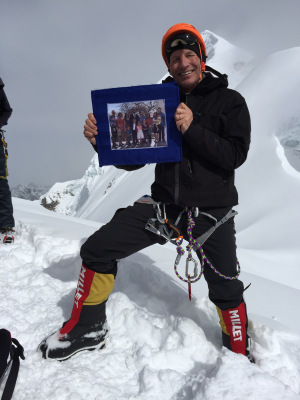
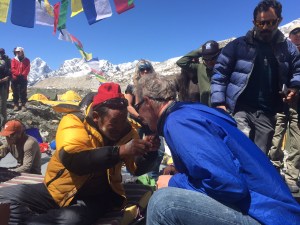
I listened to the four designated Sherpa chanting their Buddhist prayers of safe passage on the mountain for over an hour. When more than one do it at a time it becomes quite whimsical and mesmerizing.  Even the weather cooperated, with clear skies, a slight breeze, and mild temperatures.  After the prayers, they invited each of us to come up for our individual blessings, and a red string was placed around my neck. Now I have a second one to pair with the one I received from Lama Geshi.  Though I’m not superstitious in the least, I am somewhat sentimental, and plan on wearing both long after the expedition to remind me of these beautiful people and mountains!  Many of the climbers and Sherpa remained long after the official ceremony, dancing and singing and enjoying the moment.

Lobuche

Lobuche Summit

I’m finally getting some decent wi-fi service here at EBC (Everest Base Camp), so I’m able to update the past few days’ events.

I just got off the phone with Judy who is now back home in Ogden. Her flights were all on time and she even had time, while in Inchon, Korea, to visit one of the temple sites. She took pictures and I will be interested when I get back home to see if I recognize them. I’m guessing I probably will. I also got a chance to talk to Mom and Dad.  Then, Don, Ty, Livie, and Rowan.  All were just returning from the airport after welcoming Judy safely home. It was so good to hear their voices!  It made me homesick – but, I can’t let myself go there; I’ve got imageto keep my “game face” on for the next five or six weeks.

About three days ago I completed an important step in the acclimatization process by summiting 20,000-foot Lobuche. What an awesome peak!

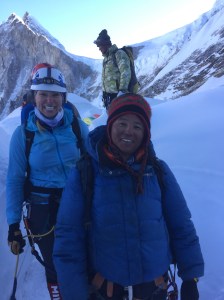
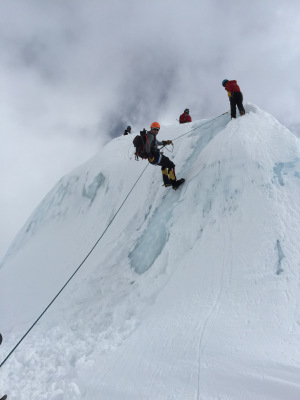
Sherpa prepared fixed lines for us near the top.  It got as steep as 45-50 degrees, and would have been unsafe without them.  It looked at least that steep from below at Base Camp, but it felt even steeper once on it.  It was fun to get to the top and see the grand views of Everest and the other surrounding mountains!  It also became the highest mountain I’ve ever summited! This was my first time using fixed ropes, other than my short training at Base Camp, and one of the steepest slopes I can remember ascending.   Tashi Sherpa reminded me that the Lhotse face, from Camp 2 to Camp 3, is even steeper!  It can be icy, as well, and much longer!  Maybe ten times longer!  Oh boy!   A lot of work ahead!  I had been able to keep up with him on Lobuche, and we were first to reach the summit, but I’m not going to fool myself to think I can repeat that on Lhotse.  Meanwhile, today is a rest day at EBC, and it couldn’t be more perfect. It’s clear and calm and beautiful!  We will be doing some ladder practice to prepare for crevasse crossings later.  I have to get used to doing it with 8000-meter triple boots and crampons. Should be fun!

Emotional, Yet Thrilling Goodbye

Goodbye

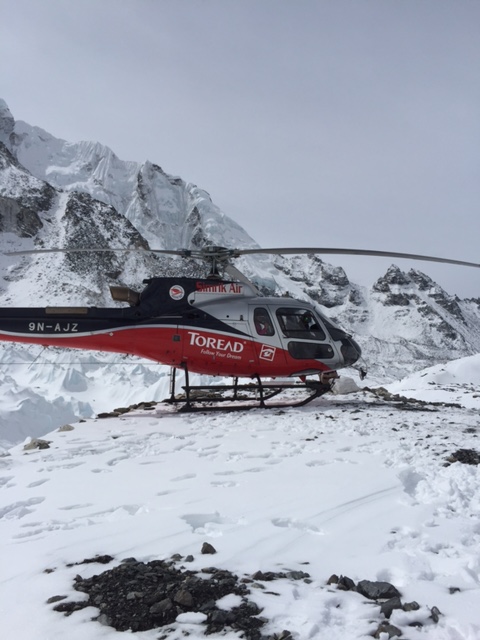
Judy and I finally said our goodbyes on April 14th.  A storm had recently dumped about 10 inches of snow here at Base Camp, so our goodbye was much different from the one I envisioned.  Greg Vernovage, the leader of the expedition, deemed the trek out as unsafe due to the extreme icy conditions.  Greg arranged for Judy and four other trekkers in our group to be taken by helicopter from EBC to Lukla for a reasonable fee.  Getting Judy out this way had been a back up plan all along due to her knee issues, but going alone would have been much more expensive.  And she probably wouldn’t have had the company of her fellow trekkers.

Helicopter

If you remember, Lukla is about 9,300 feet and Base Camp is about 17,500 feet.  From Lukla, Judy’s group boarded a fixed-wing plane to Kathmandu.  Believe it or not she was taking a hot shower at the Hotel Tibet within three and a half hours of kissing me goodbye!

Though parting was obviously emotional for both of us, having Judy fly out versus trekking out actually reduced both or our stress levels, which seemed to soften the sadness we’d both anticipated.  So, with moist eyes and while trying to avoid the spindrift from the helicopter blades, I did my best to video the liftoff.  I then watched her helicopter head down the Khumbu Valley, gradually disappearing into the beautiful Himalayan skyline.  Although our goodbye was different from the one I imagined, it was fun and maybe a little bit romantic, and really all I could have asked for!

As for me, I started the five-hour trek on the slippery trail to Lobuche Base Camp to prepare for tomorrow’s potential summit of Lobuche at 20,000 feet.

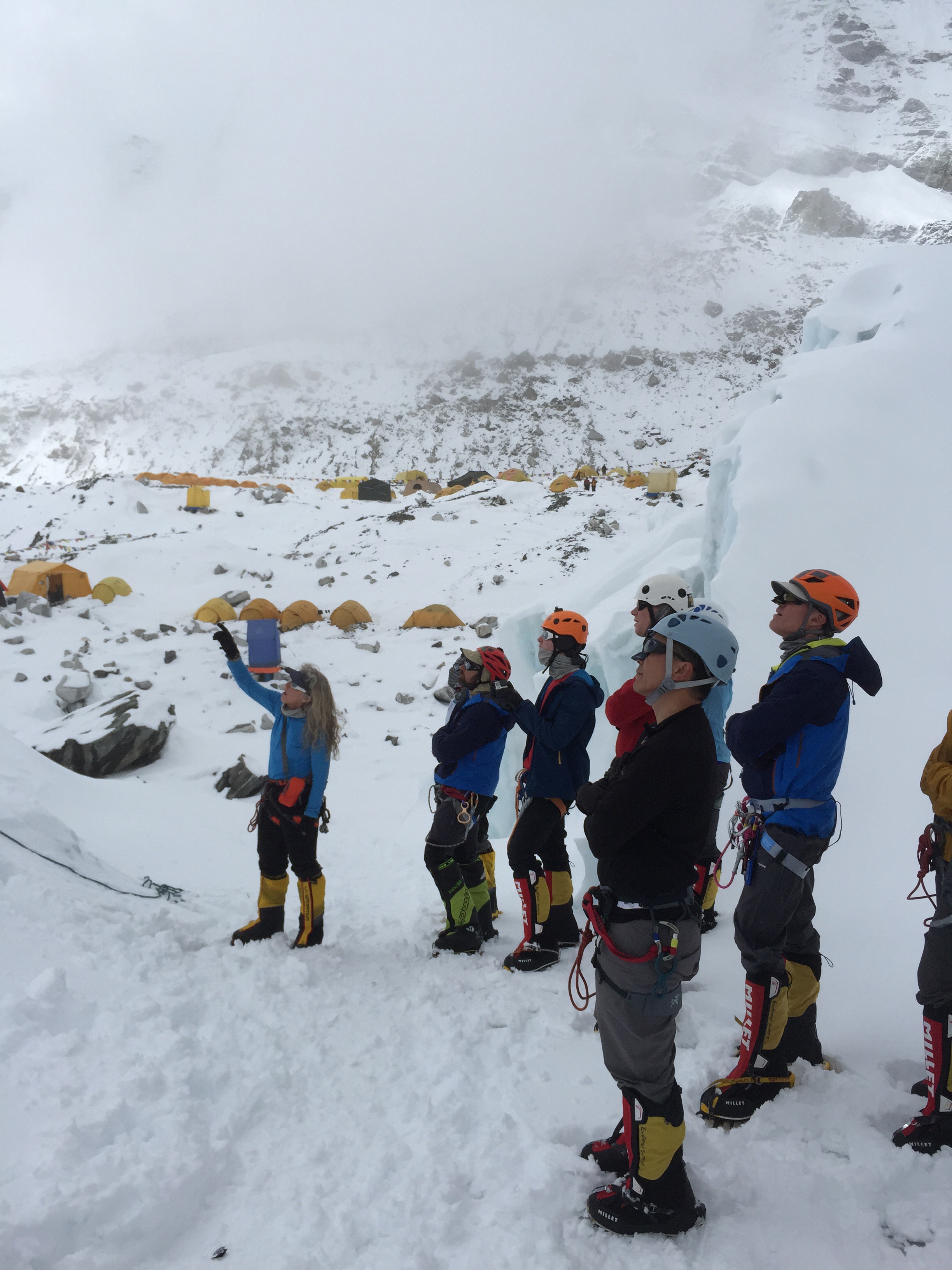
Icefall Practice

Icefall Practice

Great fun practicing in the Icefall today!  I wore my 8000-meter boots and crampons for the first time since a little practice up Malans along the Ogden, Utah foothills. They felt great!  No issues.  I also set up and used my ascender and safety carabiner, which gave me confidence I will stay attached to the fixed lines under almost any condition.

Icefall practice. A tiny part of camp across the way.

It took great effort as I’m still not acclimated to 17,300 feet. So much for the acclimatization tent I spent seven weeks in. Maybe it will have other benefits, but so far I don’t seem to have more energy than anyone else. In fact, today I think I had less after a sleepless night with a splitting headache!  Oh well, I feel much better now, other than a slightly pulled rib muscle from the training today.

Judy was supposed to have left today to trek out, but it snowed about 8-10 inches last night making it unsafe. She and the other four trekkers are now considering being taken out by helicopter from Pheriche in order to make their International flights out of Kathmandu, weather permitting. The plan is for them to hike down there tomorrow. She will be with me a good part of the way, as I will be heading back to summit Lobuche at 20,000 feet for more acclimatization before climbing up through the Icefall to Camp 1.

Judy and I will be saying our goodbyes, somewhat auspiciously, near the Sherpa memorial, just above Tugla.

EBC (Everest Base Camp)

Entering EBC

Long day yesterday from Lobuche Base Camp to EBC. We left at 8:40am and arrived at 3:00pm, with short breaks at Lobuche and Gorak Shep.  Judy hit the wall hard just out of the village of Lobuche, but bounced back quickly with the help of various energy drinks and treats.  It was also emotional as Judy and I realized that we are now only a few days from having to say goodbye.  It was a strenuous day for everyone, but we were happy and relieved to finally arrive at EBC.

Once we got established in our tents, Judy started the short little hike up to the dining tent just ahead of me.  She stopped and appeared quite upset.  I asked her what was wrong and thought she said she couldn’t breathe.  Just then, the expedition leader, Greg, appeared a little farther up and he surmised something was wrong, as well.  I yelled, “She can’t breathe!” and he immediately took action.  He called for a couple of Sherpa and oxygen and helped her up to the dining tent.  He sent me back to my tent for Diamox, a medication for altitude sickness.  I made a mess of my tent, completely unloading both of my extra-large duffel bags, but couldn’t find the Diamox.  I hurried back to the dining tent expecting to find Jude on oxygen, but instead found her sitting in a comfortable chair, her eyes red and puffy, as if she’d been crying, but otherwise appearing normal.  Greg told me that her vitals were actually quite good, but that she had an emotional episode anticipating the end of our time together!  I was so relieved I gave her a great big hug! I’m a lucky man!

IMG has a wonderful spot and is one of the first camps upon entering.  The only downside is it takes another 30 minutes to arrive at Crampon Point where climbing in the Icefall starts.  That means we have to get up that much earlier on the mornings we’ll be going through the Icefall.  The tents are smaller than the ones at Lobuche Base Camp and so we each have one of our own.  In some ways it’s good in that we don’t wake each other for bathroom breaks, etc., but not in others. For instance, only one body to keep the tent warm, instead of two.  I slept with all my down clothing on and inside my bag to keep warm.  I stayed warm but didn’t get much sleep as the avalanches roaring down off Lo La Pass kept waking me.

Lobuche High Camp

Yesterday we hiked to the Lobuche High Camp.  I was so happy Jude was with me for this one.  I wasn’t sure when we booked her trek whether it would be on the itinerary.  I had a hunch it would be because the IMG literature indicated some beautiful hikes in this area.

It is very steep, but well worth it, as the views are breathtaking!  It sits at the 17,000-foot level, so it’s a couple of thousand feet higher than Lobuche Base Camp.  The views are the best I’ve seen yet, although Everest is hidden until higher up on the mountain.  The weather has been cooperating which makes it even more enjoyable for the whole group, but there is still more snow than normal.

Judy and I are healthy and doing well, but many in our group are still suffering from stomach issues they picked up lower on the trek.  Kathmandu is the diarrhea capital of the world, ten times over!  One of the climbers on the Hybrid team hasn’t even arrived yet because he’s trying to avoid the sickness he experienced two years ago.  He acclimated in a high altitude tent like I did, and will be flying directly to Pheriche at 14,000 feet.  Others within our group are fighting colds or sinus problems. Fortunately, nobody is too sick to continue on to Everest Base Camp tomorrow.  We’re all excited to get closer to the real climbing!