“Bart felt the earthquake at Camp 1. He called Judy to let her know he was ok. The climbers were flown by helicopter back to Everest Base Camp, where Bart is now. Their plan is to pack up EBC and leave the day after tomorrow and slowly make their way down to Kathmandu. He is in good spirits and good health.”
The message above was the best and quickest way I knew of to get the message out that I was okay at Camp 1. I had Judy call my business partners, John and Margaret Hallgren, who were updating my blog when I could not, to quickly post it. I will now recount below how the day played out:
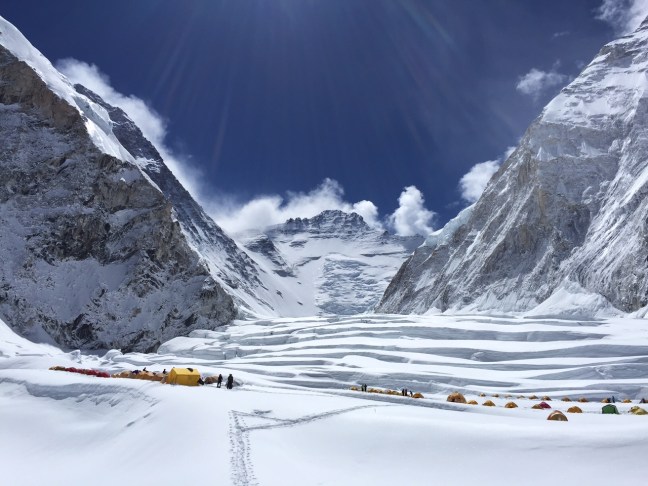
I reached Camp 1 at 8:00am and immediately called Judy on the satellite phone. She was relieved to learn I was there safe and sound, given the risk of the Icefall. It had taken me five hours and I was exhausted. The rest of the team trickled in over the course of the next hour, and I took pains to hydrate, medicate, and eat to mitigate the effects of altitude and dehydration.
The Icefall was all I expected and more! It was just as difficult as I’d been told and every bit as spectacular as I expected. It was like exploring canyons in my youth at Lake Powell, in that something interesting and exciting lurked around every corner! I didn’t think once about the danger as I crossed crevasse ladders and underneath leaning seracs! Climbing vertically up the five stories of ladders to the Western Cwm towards the end was the hardest part! Jim Davidson, my tent mate, had been leading the way until I finally passed him as he stopped to add some sun screen. He admonished me to stay clipped to the fixed line all the way into Camp 1 even though Bhote, my Sherpa, was not. I’m sure he was drawing from his tragic experience on Ranier many years earlier. Eventually camp filled up with the remainder of the team, and we had all retired to our tents to rest.
Suddenly, at 11:56am, we heard avalanches coming down from both Everest and Nuptse at the same time! The glacier underneath us bucked and heaved as they pounded the Western Cwm. Jim and I were both familiar with times in the past when they had buried tents at Camp 1 and knew we were somewhat vulnerable there! Jim yelled, “Grab your avalanche beacon, your helmet, and your down coat, and let’s get out of here!” Fortunately, I already had my down booties on, so I was able to quickly jump out of the tent to see if the avalanches were headed our way. Unfortunately, visibility was very low and we couldn’t be certain. We could only hear them and they all seemed to be coming in our direction. Just then a strong and sustained wind hit us and it seemed inevitable that we were about to be covered. We were terrified! I was dressed in down from head to toe, but saw others like Jason Ahlan running in long underwear with bare feet! We really had nowhere to escape. It seemed avalanches were coming at us from all sides! Running would hardly have been an option anyway. We had next to no visibility, and Camp 1 is surrounded by both seen and unseen crevasses!
I saw some of the team crowding into one of the larger-domed Sherpa tents and I did so as well. Several Sherpa were nervously chanting Buddhist prayers with fervor and I wondered what they were thinking, although it was fairly obvious. The wind which precedes an avalanche continued. I thought maybe all the bodies in the tent might create some air pockets when we were covered, but remember thinking this is the one way I don’t want to die. I’m so claustrophobic and I have always feared suffocating to death. But gradually the wind began to die down. I felt a sense of relief and backed out of the tent to find a couple of teammates standing there stunned. One was Nic Dumesnil, a 30-year-old Canadian, who had been impressing me the whole trip with his unusual intelligence. We immediately gave each other a giant hug and looked at each other with great relief in our eyes. Gigi, a cute young Moroccan, was also standing there, and I put my arm around her to comfort her. She turned and hugged me so hard it hurt! She wouldn’t let go! Finally, she did and again we looked at each other with great relief! Everybody began appearing from their hiding places, with the same look of relief.
We started hearing radio chatter from Everest Base Camp about an earthquake that had just wiped out the whole middle section of the mile-plus-long EBC below. It was the first time I began to rethink what had just happened. Instead of the avalanches causing the ground to rumble and buck, it was an earthquake that had caused the avalanches. It made sense! Jim Davidson, a geologist, tried to piece together what he thought may have happened at Base Camp. Since we still had few details, he surmised that the earthquake had caused half of the camp to collapse into an air pocket under the glacier the camp sits on. It sounded feasible to me, until we heard what had actually happened a few hours later.
A giant hanging glacier between Pumori and Lintgren, directly above and to the west of camp, released due to the earthquake and made its way down into a gully before gaining tremendous momentum on a cushion of air, spraying rocks and ice as it came up and over Base Camp. It tore many tents to shreds and scattered debris for hundreds of yards. We heard preliminary reports that some people had even been killed. We hadn’t yet heard how wide-spread the earthquake was across Nepal, but it immediately dawned on me I needed to let Judy know ASAP. I called her again, this time at about 1:30 in the morning, her time in Utah. I gave her a chance to sit up and get the deep-sleep cobwebs out enough to understand what I would tell her. I said I’d just experienced an earthquake and avalanche dusting, but was unharmed and okay. I told her to be prepared for news and phone calls when she awoke in the morning. I had the only sat phone, so most of the other climbers asked to use it to call their loved ones, as well. The Sherpa also asked and I had to decline because I thought my sat phone battery was low.
Meanwhile, Camp 1 was all a buzz about what might happen next. It wasn’t long before the first of a couple of big aftershocks occurred. The first one hit about 3:00pm. The glacier bucked again like the first time but I don’t remember any more avalanches. Soon evening arrived and I wondered what might happen that night. Fortunately, nothing did but none of us slept well. The next morning we were all still asking lots of questions and wondering, selfishly, if our climb might be over. Just as I was finishing lunch an aftershock of 6.7 hit and it felt almost identical to the first one. This time I stayed in my tent and waited. A similar wind came through camp again, but this time it died down more quickly, giving me relief.
The difference after this aftershock was the Sherpa. They had been nervous like the rest of us, but after this one they became more and more agitated. They began complaining that they were not being kept in the loop. They had very little knowledge of the condition of their own families and homes. They had witnessed the climbers call home on my satellite phone to communicate with their loved ones, but they had not had the same opportunity. One had tried using my phone but had no success getting through. I felt bad I had denied use to the others, but I was worried I’d run out of battery and not be able to contact Judy if we were stranded for an extended length of time.
An argument ensued between the Sherpa and an IMG guide, Emily, and she eventually radioed EBC to solicit the help of head Sherpa, Jangbu, to calm the situation. One of the main concerns was the belief that another aftershock would open a crevasse through the middle of camp, swallowing us all. When attempts to dissuade them of that belief failed they insisted on leaving immediately by way of the Icefall. Though the Icefall ladders had all been destroyed and many of the seracs had tumbled making it extremely dangerous, they were ready to give it a try. Jangbu was once again able to dissuade them of this misguided notion. Realizing they would be forced to spend another night, they anchored a climbing rope at various places through the middle of Camp 1 and clipped into it for the duration, believing that would stop a fall into the depths should a crevasse open up.
I actually slept better the second night. I hadn’t slept more than an hour for the past three nights combined, so my body was so fatigued I slept better even though my tent mate, Jim Davidson, was being interviewed on and off through the night by CNN on my sat phone. I had been wrong about the battery on my phone. I was actually running out of usage minutes, not battery. A call to my provider restored another unit, about three hours, and Jim urged me to let him use it for the interview with a promise to repay me. The sat phone seemed to work a little better outside the tent, so he was in and out several times during the night. I learned later my son, Don, heard the interview at home. Little did he know where and how it had taken place.
Our third day was clear enough to start our evacuation, and since none of us had been swallowed by a crevasse overnight, we all packed and lined up about 200 yards away and waited for our rescue helicopter to appear. I have to admit I was somewhat reluctant to leave. I kept wishing we could make the relatively easy hike to Camp 2 to continue our rotation. I was in a bit of denial that my dream of climbing Everest was almost certainly over. But soon two helicopters appeared from the direction of the Icefall and began ferrying us two by two back to EBC. My toes were cold as I stood in line waiting my turn despite wearing my expensive 8000-meter boots. I kicked the snow and wiggled them to avoid frostbite in the sub-zero temps. The rest of me was warm, as I had been wearing my summit suit since arriving, even to sleep in. It was finally my turn after about an hour and I boarded the seatless helicopter with a light pack and one other Sherpa. We left our climbing gear behind for weight purposes, and I worried whether I’d ever see it again.
The ride down to Everest Base Camp was thrilling! After a slow lift off and flying over the last half mile of the Western Cwm, we literally plummeted down the Icefall. My heart came up into my throat as I realized there was absolutely nothing to hold on to. Sitting Indian style I held my balance the best I could, and within several minutes we landed at IMG’s EBC site! The Icefall had been destroyed by the earthquake, but we passed by it so fast I couldn’t tell. I didn’t see any of the 50 or so ladders I had crossed coming up. Greg Vernovage, the expedition leader, and the rest of the staff were there with a hearty greeting when we landed. Mike Hamill, one of our favorite guides, quickly poured just two and a half gallons of fuel into the helicopter, and sent it back up to retrieve the next in line. It was probably about 8:00 or 9:00am by then, and I watched on and off till about 4:00pm for the last of about 160 climbers to be rescued.
During the day I learned of the heroic effort by so many that had occurred over the past couple of days right in our IMG camp. Due to its size and location (untouched by the avalanche) Greg had volunteered its use as a triage center, converting our dining and communications tents to trauma centers. By the time I arrived, it had been restored to its prior state. It was hard to believe as I heard story after story about success and failures in keeping people alive. One person had died twice right where I was sitting only to be revived and flown to a hospital down valley. Another, unfortunately, wasn’t as lucky and had died during the first night, despite efforts by a cardiologist acquaintance of mine, Ellen Gallant, to save the 25-year-old Sherpa who died of head trauma. Four bodies in their sleeping bags (used as body bags) covered by a blue tarp lay not far from my tent, reminding me of what must have been a horrific 23 hours, which was the amount of time it took from when the avalanche first hit to the time the last survivor was flown out – 23 hours of hell I had thankfully missed. However, my friend, Fraser, from Australia said as hard as it was it had its rewards, as I’m sure it did by the stories I heard.
That night as we sat at dinner, Greg recounted all that had happened. He was proud of everyone! And we were all so proud of him. Among other things he’s a former Olympic coach to the Women’s Volleyball Team and had impressed me throughout the expedition in many ways. I was particularly impressed when he confessed about a difficult decision he had made during the crisis. When HRA (Himalayan Rescue Association) ran out of oxygen, and more was needed to keep people alive, he volunteered the climbers’ Os, doing so even at the urging not to by our head Sherpa, Jangbu. He argued to bring it down from camps that had already been destroyed and whose climbers were either dead or injured and unable to continue anyway. It was a good point because our expedition hadn’t officially ended yet, though the writing was inevitably on the wall, but Jangbu could see the potential to keep it possible. Greg insisted there were those whose health may be compromised and he would use the climbers’ oxygen immediately for them. In my eyes, Greg became a true leader at that moment, even though I knew it meant I’d hear what I would dread hearing – our expedition was over. Indeed, the announcement to end it came in his next breath.
The expedition was officially ended. It really came as no surprise, but wouldn’t hit me emotionally till a couple of days later as I departed EBC. That’s when I came to the realization that my life-long dream of climbing Everest was most likely over.
 Mt. Everest
So glad you are safe, Bart.
LikeLike
So glad to see this post.
LikeLike
So glad you are recording
this experience and so happy you are home.
LikeLike
Yes, me too😊
LikeLike